| Two units acquired in
2015 and 2016
Data measured January, 2016 Since the first two were labeled as EB-1 and EB-2, the sequence was continued. All 4 were found on ebay. These two are all original; the FS/AL surprised as the foam hasn't rotted. The adhesive holding it to the cone had to be repaired in places so it was lifted from the cone and reapplied. The CS/AL has no wear whatsoever; it was never used. There is no evidence of screws being applied and the original solid wires, now removed but kept, were still attached to the terminals. Both have phenolic spiders and aluminum speech coils. The EB-4 unit is of a later vintage, probably mid 60's. Note the dust cap in the second photo.
|
|
PHOTO 1
|
|
PHOTO 2 The dark spot at 9 o'clock on the annulus of the speaker on the right is a drop of glue applied to seal a hole probably caused by a hungry cricket or moth.
|
|
PHOTO 3 This photo shows the phenolic spiders.
|
| FIGURE 1
The blue curve is that of EB-3, the FS/AL. That's just about the only difference that can account for the lower Fs. The CS would make a better midrange; the stiffer annulus would slightly improve transient response. |
|
| FIGURE 2
The red curve is EB-3, the FS/AL. Also, it's the longer curve. The black curve is EB-4, the CS/AL. It is also the smoother curve. Both exhibit a rise around 5 khz but can be tamed if preferred by using a second order low pass section at about 4 khz. Both curves were obtained with 0.25 watt applied with reference to the measured impedance at 1 khz. The EB-3 is 8.6 ohms and the EB-4 is 8.0 ohms at that frequency. The mic distance was 0.5m and the generator was gated so as not to pick up room reflections. 0.25w at 0.5m is equivalent to 1w 1m. |
|
|
ADDENDUM May 5, 2026 Since the purchase of the Pocket CLIO (Sept. 2019) some 3 years after this page was written, several addenda have been added to many pages. Here's another. The Super 8 may sound bright to some due to a rise in response in the octave spanning 3khz to 6khz. This is exhibited in all Super 8's and may be due to the effect of time on the paper diaphragm, some 50 to 60 years. It may also be inherent in the unit at the time of manufacture and may very well be the reason why many of Briggs' three way systems have the Super 8 and the Super 3 tweeter facing the ceiling. This response rise can be seen in fig. 4, the green curve. With the Super 8 facing the listener, this rise may be objectionable. This addendum proposes a fix for that.
|
| PHOTO 4
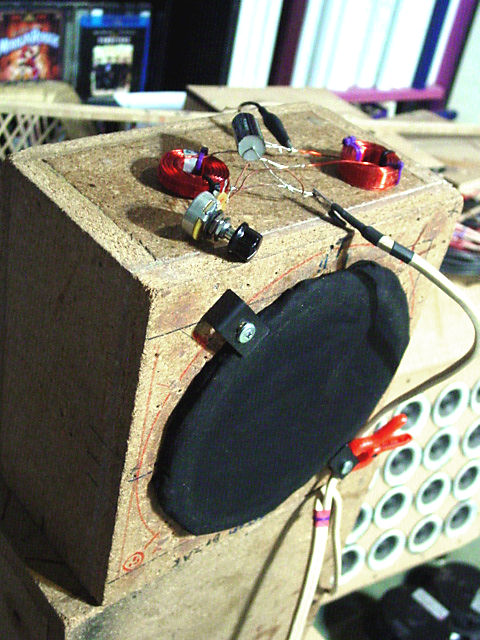
The test setup with the notch (band reject) filter. The sealed box has an internal volume of 348 in^3 and is stuffed with 100g of Australian wool, washed only. Briggs used wool, compressed to about an inch in thickness to line the innards of his systems. The black covering is used to protect the open voice coil. The spider is the original phenolic type.
|
]
|
| The
phenolic centering device, photo 5, used prior to the corrugated canvas
type now used. Its appearance is what gave it the name, spider, which
stuck to this day despite that canvas centering devices hardly resemble
a spider.
The wool is available from The R. H. Lindsay Company Check the APPLICATIONS page, top right paragraph.
|
|
| PHOTO 5
|
PHOTO 6
|
|
FIGURE 3 The notch filter inserted into a crossover. First and second (dotted) orders are shown. A 15W or 25W wire wound potentiometer can be used instead of a fixed resistor. The overall speaker output level is adjusted with either a 50W wire wound potentiometer or an 8W or 16W L-pad, depending on the speaker's impedance. In some Wharfedale crossovers, pin 1 of the potentiometer is not connected to ground, hence the dotted line from its pin 1.
|
|
FIGURE 4 The upper green trace and the upper blue trace (bottom) are the speaker response and THD at 1w1m The black and grey traces are the response and THD with the filter The filter has also reduced THD at its worst point by ~7dB, from 1% to 0.447%
|
|
FIGURE 5 This shows the impedance curve of the notch filter. The effect on the speaker will be the inverse of this, i.e. vertically flipped.
|
Back to the loudspeaker main page