Super 3 in W70 chamber


This study was inspired by a query on an audio forum in which was asked if anyone knew of the effect of floating the tweeter in a small unpadded box in which the back waves from that tweeter will reflect off the back and sides, thus interfering with the frontal wave.

These chambers came with the tweeters at the time of purchase. Later, I became curious about that aforementioned effect but made no attempt at looking into it as I was involved with another project. Eventually, it ended up on the infamous back burner where is was almost completely forgotten, until that query was seen.


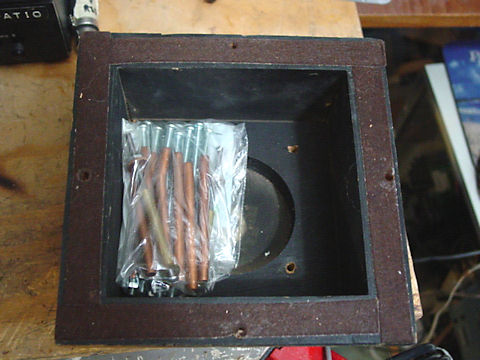
PHOTO 1

One of two such chambers with associated hardware. The copper colored spacer tubes are of my making for a study on the W90 in which the tweeter magnets are not recessed into the cavity. The light brass colored spacer tube on the left is one of the originals, which are 3/4 inch shorter.

My study on the W90 was dedicated to its woofers only as a very detailed study was already done on the W90.  It's titled   The W90 Project 

It was discovered after making separate isolation chambers for the two 5" units and two Super 3 units in lieu of the rectangular chamber which measured about 6" high, 5" deep and was the full width of the system. There was no padding in that chamber. I abandoned my research as it seemed there was no reason to reinvent the wheel.


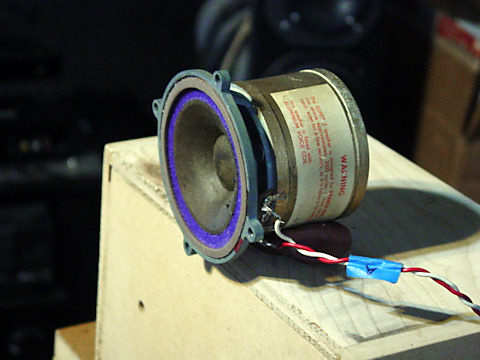
PHOTO 2

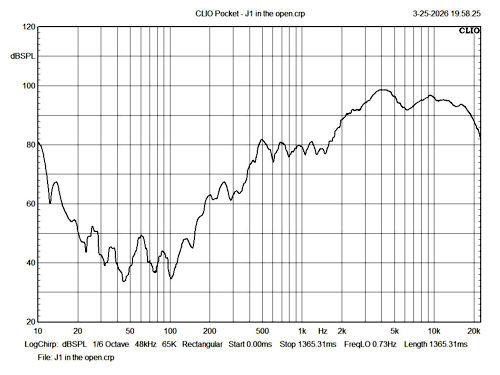
Super 3 in the open. While it may seem obvious, it's here to show what is meant by 'in the open'.


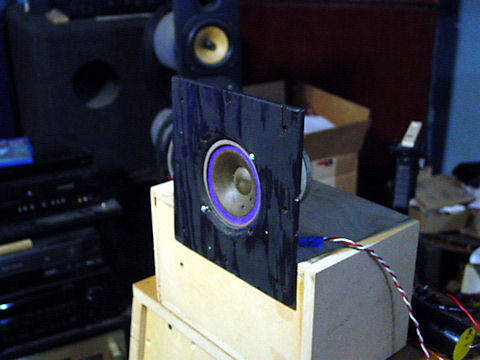
PHOTO 3

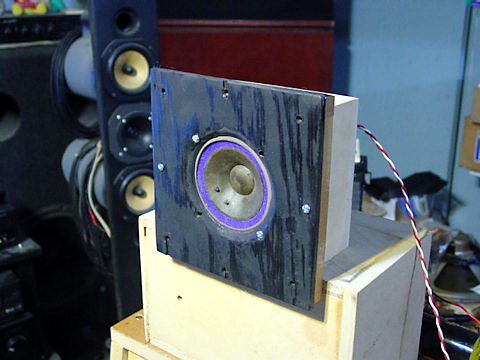
Super 3 on 7" square baffle, which is actually a shipping tool.


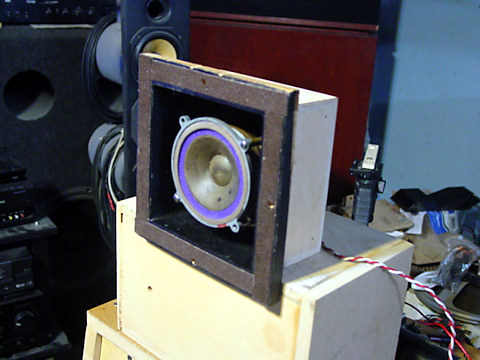
PHOTO 4

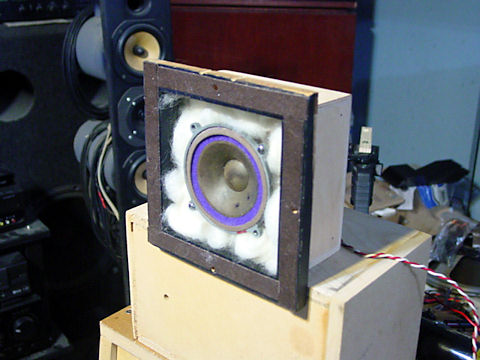
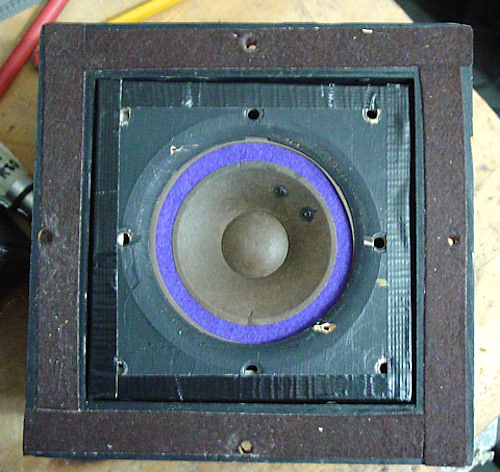
In the Wharfedale isolation chamber


PHOTO 5

wool stuffing


PHOTO 6

Sealed isolation chamber, with or without wool.


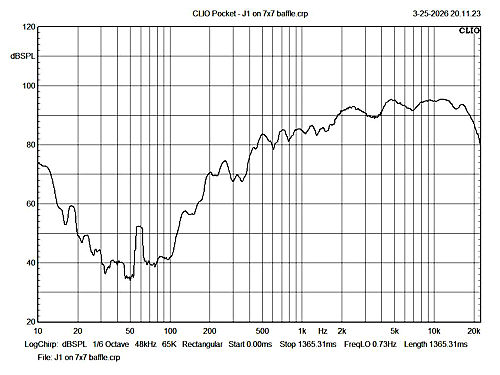
Figures 1 and 2 show the effect of a 7" by 7" baffle on the response. It should be noted that Mr. Briggs used such a baffle in the SFB3 open back system. A baffle of that size will isolate the front and back waves to about 2khz, which is 0.6 octave below the tweeter's high pass filter of 3khz. For the tweeter to work in the open without a baffle, the crossover frequency would have to at least first order at 5khz.


FIGURE 1

J1 in the open

FIGURE 2

J1 on 7x7 baffle


FIGURE 3

J1 in Wharfedale chamber open front

RED-wool fill    GREEN-no fill

The wool has little effect


FIGURE 4

J1 in Wharfedale chamber closed front

RED-wool fill GREEN=no fill

Here, the minimal effect of the wool can easily be seen. Closing the front of the chamber has the greatest effect.


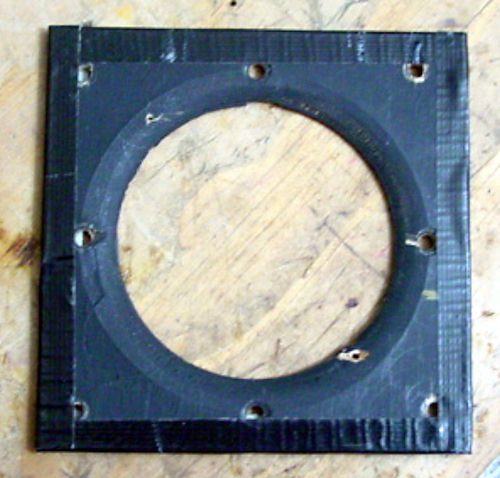
This is an idea that came to mind. The gasket on the tweeter is about 3/8" below the outer foam perimeter so a baffle of 1/4" in thickness will work. The opening of the chamber is 5" by 5". If the baffle is cut a little smaller, duct tape or electrical tape can be applied around its perimeter to make a snug fit. Wool or other damping material can be stuffed inside, the effect of which may  not may not be audible. see fig.4 between 2.5khz and 3khz.


PHOTO 7


PHOTO 8


Back to the Wharfedale Index

Back to the loudspeaker main page